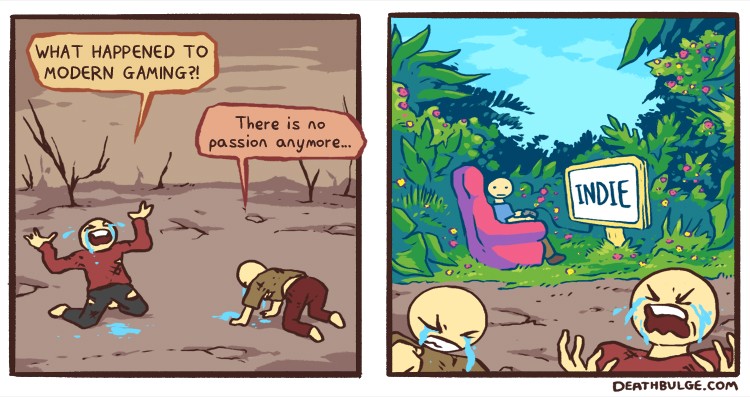

Comic: https://www.deathbulge.com/comics/441
Alt text: Yeah yeah, there's always exceptions, I mean look no further than the game in the 2nd panel, not the most thrilling gameplay, is it?
You must log in or register to comment.
There’s definitely amazing indie games, but there’s also hundreds of shitty and terrible indie games for every decent one.
And thats the natural way of the world. Without shitty artists there would be no good artists, because every good artist was once a shitty artist.
Sure everyone needs to start somewhere. I’m just saying it’s also very far from all sunshine and rainbows in indie-game land.
I mean don’t play the ones you don’t want to…?
Also, I’m a lot more willing to gamble on a $20 game than an $80 one.
My experience has been indie games are pretty well vetted if they are able to sell for $20.
Plenty of $3-5 games that are a bit of a gamble though. Even if it ends up being kind of lame I figure it’s funding for the developer to make another attempt.
Adding on to that: Sometimes these indie devs, who made a cool thing as a passion project and get rewarded with life-changing money via sales, then go on to continually update the thing since they can now devote time to passion. Thinking Minecraft, Terraria, Vampire Survivors, Stardew Valley as my personal “I have sunk hundreds of hours into this title” games. That $3 game might have good bones and just need time to flesh it out.
Also the communities will rally around devs that don’t use predatory pricing and cash-grabs. I know I’m not the only one who bought more copies of some of these games (or their OSTs, donation DLCs, Patreon, etc) to gift or even just as a thank-you when something updated and gave me more content or more polished experience.
My game list were so popular it was almost cliche, but we can’t really predict what the next great thing will be until it’s there and pricing your new best-seller at $3 means you get exposure and good will.
Yeah you are right there is plenty of small slop games that were clearly made as a cashgrab full of microstransactions and bugs. But i jist wanted to point out that its not so black and white.
If you read the negative reviews on steam, you can often filter these shitty ones out. Also, be suspicious by default of free games. There are some that were made by some game dev just having fun but most want to make money some way or another and f2p monetization is often pretty toxic, like adding a long grind just to sell ways to avoid it or p2w mechanics.
I haven’t felt like I’ve gone wrong by generally just buying the cheapest well-reviewed games on my wishlist, occasionally stretching the budget to grab a mid-priced game I’m interested in and rarely going for a AAA priced game. Means that I get to some great games later (eg, Hollow Knight is one of the more recent ones, highly recommended btw) but it’s been a great way to experience a wide variety of games from today and the last 15 years for not that much money.
I can respect a shitty indie game that has passion. You can tell a lot of people are ALMOST there on itch.io sometimes. And its just so close. Or just something that doesnt click with you. But thats ok.
“Or just something that doesn’t click with you. But that’s ok.” You’re going to rile up the rage addicts with this calm logic.

It’s funniest when they act like their rage is justified. Or destroy their own things.
deleted by creator
I don’t think the intended message is that all indie games are great. The message is that if you’re frustrated with AAA-games and haven’t considered indie games, you should.
there’s also hundreds of shitty and terrible indie games for every decent one.
I would skip those and play the good ones
Yes.
Ratings systems and reviews aren’t perfect, but they are a good starting point.
I would play them both. Because fuck me I guess
If you dont play a game for 2 hours and didnt buy it more than 2 weeks ago, you can refund it if you bought it on steam
That’s why the Indie side is a full ecosystem.
Shitty games die and fertilize the ground so that all the good ones can grow.
If a AAA game dies, it takes another 6 years for investors and executives to gain the balls to maybe risk spending the money to make another game, so it fertilizes nothing, just sits and rots on sand.
Oh no I spent $3 on a game that could use some more polish.
Honestly even if the game ends up being kinda lame I won’t ask for a refund.
There’s a lot of indie games costing $30+ these days
There are more good indie games than ever. It doesn’t bother me that there are also more bad indie games than ever. We have a variety of ways to separate the wheat from the chaff. And I don’t think the ratio has ever been better than 1:100 in any genre in any time period. 🤷♂️
yes but more chances to be good. variance is expected ln chances. the choice is your’s to pick which ones to play. no one said you absolutely had to play the shit ones. use your free will.
That is why indie gamer bloggers still exist, to write about which ones are bad and which are good.
All the old cool shit still exists even if its not “mainstream”.
I mean… if you only have a console (or even worse: only a Smartphone) I get why it looks like that to people. Some people apparently don’t even have a PC or laptop anymore.
I’m genuinely upset at how miserable the mobile scene is compared to the rest.
I’ve got a phone that’s orders of magnitude above a TurboGrafx or a Game Gear, but 95% of the games are GACHA crap or so ad bloated as to be unplayable.
Yeah, it’s abysmal. I still rock a OnePlus 7 Pro from 2019 with /e/OS, that damn thing can run Crysis (I tried, works with Winlator - lots of compatibility bugs though). The SoCs are so powerful Valve designs a whole stand-alone VR system around it able to play full-blown PC titles. Modern phones got crazy performance.
Good games without all the extorsion money simply can’t compete in the attention game though and people won’t pay money for something worthwhile if there’s a storm of crap “for free”. The internet and digital spaces in general got utterly broken by surveillanve capitalism. But, you see… it’s for ✨the economy✨.
people won’t pay money for something worthwhile if there’s a storm of crap “for free”.
I’ve got the first six FFs, which were remastered and released on Mobile. Got me through lockdown, when I was just trapped in a socially distanced office with nothing to do.
Like, it’s definitely possible to make - and sell - a good game that works well on a phone.
The internet and digital spaces in general got utterly broken by surveillanve capitalism.
Ain’t that the fucking truth.
Personally a big thing that holds me back from even seriously considering mobile gaming as an extension to normal gaming instead of “the best you can do when you don’t have access to better devices” is the input side. I hate touchscreen controls for anything with real time action because touching the screen obscures it from view, plus you don’t get the tactile feedback of buttons that makes it trivial to play without needing to readjust your finger positions constantly.
And I know there are external controllers you can use with phones, but if I’m making space (and remembering to bring) one of those, I might as well just bring my steam deck or even the switch instead.
I mean, yeah, why not bring a dedicated device, but the shit you can do with a phone and a controller is not unimpressive. I’ve got anything and everything psx and before emulated (including SCUMM and DOS, so I could play old lucasarts or sierra games. Fuck if I remember how to do that. Something on fdroid) on a oneplus 7 pro and galaxy s3.
I think the money aspect is a big one with this. Someone with a Steam Deck and/or Switch doesn’t see the need (well, Switch maybe unless it’s jailbroken), but if you just want something and money is tight then a new 50€ controller and your existing phone gets you way further.
50€? What has happened to the controller market in Europe while I was in the toilet?
EDIT Cheap gamesir for $35 USD. I’ve got an old gamesir g3s. Something like 10 years old. Still works great, i might have to reset it with the pin if I’ve been using it 8 hours straight.
I have a GameSir G4 and it’s trash, utterly awful input lag and the connection never worked correctly with any device other than Android either. Basically unusable without a cable, I’d never recommend their stuff.
It’s unfortunate that the attention economy is what sells the existence of these indies in the first place.
Slay the Spire!
They need to release the sequel on mobile already. I’m dying here
Well, as a consolation prize, you can run PPSSPP on Android, Linux, and possibly iPhone. You can also find archived ISOs for pretty much every PSP game ever made such as Monster Hunter Freedom Unite, Monster Hunter Portable 3rd, Crash Twin Racing, Phantasy Star 2, etc.
There is nubbys number factory
And thats it, there are no other good mobile games
The only mobile game Ive purchased is Monument Valley, I really liked that one.
Only counting (intended) exclusives, uhh…
osu!stream…
Uhhhhhhhhhhhh…
Mekorama.
Uhhhhhhhhhhhhhhhhhhhhhhhh…
Even if you only have a console, it’s really not THAT bad especially if you’re not a conscious consumer. Like my kids love their Switch 2 games because they don’t really know any better yet. They see me playing different games on my PC or even indies on the Switch and look genuinely interested so I’ll get them to play those soon enough to expand their horizons (and eventually let them know how shitty a company Nintendo truly is lol).
But Switch exclusives are amazing anyway. 1st party Nintendo games are almost always good. And ever since Switch 1, pretty much all of the indie games are available on the platform. And since indie games don’t really need powerful hardware, it’s a great experience.
The quality is good, I give that to them. But their pricing, ownership model and especially opinion about copyright is abysmal (weren’t they the ones trying to patent relative motion?). Nintendo has some genuinely good artists and engineers who clearly love their job but they take the carrot-and-stick approach to the extreme and it’s disgusting.
deleted by creator
You can emulate tons of consoles and games on your phone though
Just sucks without physical buttons. Using button on the screen covers things up and is much harder to use.
Agreed. Some emulators do have the option for haptic feedback via the vibrations. Which still isnt ideal but i found it quite useable for certain types of games.
Or you just buy a bt/usb controller for 20-50 bucks. A few phones even have usb-c dp alt mode and you can enjoy the games on the big screen.
Got a Bluetooth controller. Changed everything.
There are a few really good gamepads (or smartphone holders for e.g. Dualshock).
Taking a premium phone from a few years ago and slapping a controller on it genuinely makes an awesome mobile console. And inbetween all the garbage there even are a few really good native games, such as the remastered GTA Trilogy.
A lot of great games have been ported to phones. Then you have emulation. I am playing games up until 3DS on a 6yr old phone with a blue tooth remote that sticks to the back of my phone.
Do you have the screen vertical or two screens horizontal? I’ve been trying to get through a run of radiant historia and I keep falling apart because I can’t get the screens lined up right
I’ve been doing the screen vertical. I have an McCon that can change the direction you place the phone on the remote.
if you only have a console
… then your an idiot in the first place.
If you spent $700+ on a gaming only device that you can’t use for most “PC activities” (office, banking, browsing the web, etc), than you obviously set your priorities wrong.
Most indie games run on 10 year old budget laptops/PCs and you can get them definetly cheaper than a console.
Do you know how goddamn cheap an old console can be? It’s insane value for money for entertainment. You do not have to buy the latest console. I played Star Wars Racer for hours the other day with my nephew, on the old Nintendo 64 in my games cupboard, gathering dust but still working perfectly.
Yeah cool, but the meme is about modern gaming…
The meme is, but you were saying that consoles are hella expensive. I was just saying they do not have to be.
Of course you can buy a 15 year old console for $50 or something like this. But will it run any modern games? Obviously no.
I can also probably buy a 15 year old PC for the same price, install Linux and use it as a daily driver and maybe even run some modern Indie games.
So really not sure what’s your point in this discussion when you change the starting point…
Unfortunately a large percentage of the population (subconsciously) believe that if a product isn’t marketed to them, they shouldn’t touch it.
To put it more accurately, they don’t look. They don’t seek. They wait for it to get served to them via an algorithmic feed.
I think this is a core issue with all of civilization, right now.
We will mock this, but we all use Product X in industry Y, which is the more well-known brand of that industry. We don’t know that if we explore Z Niche Store, we can find excellent replacements for Product X that can take a little more effort to use and appreciate but are valued more for it.
You can fill in that mad lib in several ways; it’s very much down to which industries you pay close attention to.
How much difference does it make for your life?
What’s the fraction of your time you spend in it?
How long do you have to work to earn the money to pay for it?
As I see it, those are the kind of question which dictate how much time one should spend in trying to figure out the best option for something.
Trying to figure out the best cost/quality option in, say, soap or discardable plates for a party, is seldom worth it versus spending time figuring out, say, what’s the best house or car to buy or even just a good sofa for you living room or mattress for your bed.
And yeah, plenty of people won’t spend anywhere as much time researching even a purchase they’re going to spend the next 30 years paying for (the house), which IMHO is pretty sad - if something will cost you tens of thousands of hours of your life to pay for (by working to earn the money to pay for it), spending many hours of your time in making totally sure you’re getting the right one is the wisest way of going about it.
So, it’s totally logical for casual gamers to invest in their game purchasing decisions the same time and care as they do for, say, their soap purchases, and it’s logical for people who spend many hours a week playing games to care a lot more about finding the best games for what’s probably their main form of entertainment.

Sounds like a them problem
Technically it’s more of a Deez Paradox.
And there’s also those, who will throw a hissyfit if they’re forced to play something without modern AAA graphics, don’t want to play “woke” games, etc.
Same thing for movies, music, etc. The people that piss and moan about their media being terrible are the ones that can’t be bothered to lift a finger to seek out something better. They only bother with media that falls into their lap, and that’s petty much all determined by studios that care more about profits than quality.
I think it’s still a bit of a fair critique.
There were always sequels and garbage 30 years ago but someone who maybe only saw a movie a year the chance that it would be a new IP were higher. Studios are allergic to risk so they would prefer a mediocre known quality.
That said you’re right there’s more media than ever and tones of interesting options in niche areas. That said discoverability is not free. You have to put in a decent amount of effort and even still you might end up watching a niche indie darling that was never for you and come out disappointed.
For someone who only periodically dips into a form of media I think the current landscape is undeniably worse than it was and I understand when they complain about it.
Streaming has changed films. With on-demand TV, and more affordable, higher-qualitt home theatres, the only films worh spending money on seeing in a cinema are the big eye-candy films.
However, those streaming films are often lower quality if they weren’t also released in cinemas.
On the topic of indie films, can people in-the-known share some suggestions for what’s worth watching?
Brick, Moon, Sunshine, Seven psychopaths
I don’t know how many of those are actually indie but I feel like they all flew in under the radar.
Back in the day, I used to just look up the different indie film festivals, see what was nominated/won, go watch the trailer, and pirate the ones I was interested in.
Found a lot of films this way.
Grey Man, purely for Captain America in a pedostache hamming it up as a villain.
Exactly. It’s like when people complained that rock and roll died again at the end of the 90’s. Sure, if you don’t seek out better music and just take what’s handed to you by MTV and the radio (or what Spotify shows on its Home screen these days), then music is terrible now. If you go digging, you can find all kinds of amazing stuff. Same goes for gaming. Good studios get too big or bought out and ruined by people who only care about money, but if you dig around you can find all kinds of good stuff.
The stuff that “lands in your lap” was actually shoved there by a multi-million dollar marketing budget. That almost certainly means the product itself is meant for mass consumption and may not be that compelling or interesting. If you’re willing to spend the time and effort to look around and play some bad games along the way, you’ll find the good ones.
That’s what folks don’t seem to realize, it’s always been about money and the entire industry has always been toxic and what we have now is it’s natural outcome. There’s always been non mainstream content and more recently it’s become more accessable which hurts the profits of the industry meaning they do less innovating because they worry about the ROI beyond anything. This drives more people to non mainstream which increases its quality. It just requires effort to find.
Ultrakill, Deltarune and Celeste are my favorite video games, all indie I think.
I love deltarune and I enjoyed the ultrakill demo, never tried Celeste though
Most games I play are indie ones cause those are the best imo
never tried Celeste though
How solid is your relationship to your gender?
honestly unsure
Well, then Celeste sounds like the perfect game for you!
Is this really the best takeaway from the game? I love Celeste and I’m pretty solid with my gender identity. The music and game mechanics are the best parts. You reference the story, which ain’t bad, but definitely not where the game shines.
Ehh different people take away different things from the game. One of the pivotal experiences that lead to me finding out I’m trans was beating Celeste.
not played those but deltarune, undertale, and celeste are on my planned list, and might check ultrakill out
i rlly like hollow knight and hollow knight silksong, which are 2 very good indie games
the main non indie ones i play are minecraft and the legend of zelda series
Minecraft is an indie game that became super popular.
its not indie now
was originally
Depends on how you define indie. By my definition, Deltarune is still indie but made by a quintillionaire so like, meh. Celeste was indie when it was just a fantasy console bs thing.
I mean Deltarune was made by toby fox who became a millionaire from his other indie game Undertale. I think it definitely counts.
I did say “is still indie”.
You also said, “but made by a quintillionaire,” as if that is a point lowering its indie status, and as if money is the defining aspect of indie vs. AAA.
So if an indie game blows up because it’s great then it’s not indie? That’s a silly way to define it.
Have some mid-sized studios co-opted the term? Sure. Expedition 33 is on that AA spectrum, but a game by a very small team? In what definition is Celeste not an indie game?
Here’s one definition. If you go to the Steam page for Deltarune, it says “tobyfox” as developer, that’s a (nick)name. OneShot (2016) says “Future Cat LLC” but that seems to be made up since Steam asks for “company name”. Celeste’s “Maddy Makes Games Inc.” seems real, however. Therefore, Celeste isn’t indie.
You still haven’t defined anything. So if a game is only made by one person, it’s indie? Games made by very small teams aren’t indie?
Look, I get it, “indie” is actually a bit of a nebulous term, and is often co-opted by medium/large size studios who want to pretend to be “better” than the AAA games, but no reasonable person would call Celeste “not indie.”
So if a game is only made by one person, it’s indie?
The first two examples are clearly made by multiple people. They just haven’t registered a company. I good rule I found, not for games but just in general, is that if it’s a registered organization it’s probably not as good as you think it is otherwise.
I think the most accurate definition is “produced without a publisher”. That’s the thing they’re independent of.
Where it gets grey is things like “okay it has a publisher, but they’re tiny and cute and only publish indie-feeling game”
So the “feeling” of indie is “made by a small group of people with a shared cohesive vision and minimal outside influence”, where publishers tend to be large sources of outside influence, and teams larger than, like, 50 people tend to be unable to all have a truly shared cohesive vision. And a single person, by definition, always has a shared vision no matter what they make. But if a publisher is low-touch, or brings a game that’s basically done to market without asking for changes, and the game feels cohesive and personal, then that’s good enough.
Right, that’s where the other definitions come in. I’d say itch is a distributor rather than a publisher, but even if you don’t care about that distinction, it is definitely the case that itch doesn’t tell the developer to do anything. So publishing on itch doesn’t affect the vision for the game.
Nintendo… I mean kinda yeah. They’re a weird one. Some of their games they’re just the publisher, and there is another developer with a different name. But some things they do actually develop and self-publish. And some of the games have surprisingly few people working on them…
There may actually be a few Nintendo games that are kinda indie, oddly enough.
I think the most accurate definition is “produced without a publisher”. That’s the thing they’re independent of.
Yeah I think it was the original meaning. And New Blood, ultrakill’s publisher, is only doing small games so far IIRC (also they have some ridiculous merch for their games alongside some pretty cool one) so they fit the “indie-ish” publishers category I have
And ultrakill probably sold the least out of these 3 but actually has a publisher (it’s also my favorite of the 3)
both ultrakill and dusk look like arse, and that might turn people away
So true! If you ignore big corpo and their slop, we actually live in a golden age of gaming.
We always have and I’ve often ignored big corp.
Games that I have enjoyed that are indie:
Its a wild ride I recommend!
-
https://store.steampowered.com/app/1296610/Peglin/
If you like peggle its a fun little game. -
https://store.steampowered.com/app/1218210/Coromon/
Its like pokemon and amazing pixel art. -
https://store.steampowered.com/app/1082710/Bug_Fables_The_Everlasting_Sapling/
If you liked Mario RPG titles this is a fun one.
What are your picks?
https://store.steampowered.com/app/1569580/Blue_Prince/
A fun puzzle game with lots of layers to it. There’s the original, stated goal. But as you work towards it, you discover lore that points you towards other puzzles.
This game is genius until you’re determined to truly finish it… Then the next level of the puzzles border on insanity.
Yup. I’m working on the final puzzles right now. Just finished one of the final two doors. I wouldn’t even be sure there was a second puzzle if it weren’t for hints on the wiki 😳.
For puzzle games, my goto is baba is you
Interesting! ill take a look.
No way Undertale/Deltarune fans haven’t shown up yet
This one has arrived
Genuinely crazy that it so rarely gets mentioned in the “we’ll never see another original game again!!!” hysteria.
Larian Studios also has a string of bangers that should mark it out as the next Bethesda or BioWare, but it also routinely gets ignored.
CRPGs aren’t as popular as a genre is the main reason
-
Jazzpunk https://store.steampowered.com/app/250260/Jazzpunk_Directors_Cut/ - Everyone should play Jazzpunk. Watch the trailer, and read no other reviews, just play it.
-
Far: Lone Sails https://store.steampowered.com/app/609320/FAR_Lone_Sails/ - a gorgeous art piece, a good story that develops through the gameplay, worth your time.
-
Void War https://store.steampowered.com/app/2853590/Void_War/ - Void War is FTL crossed with Warhammer 40k, but it’s not just a reskin. If you ever wanted more FTL gameplay, Void War is it.
-
The Red Strings Club https://store.steampowered.com/app/589780/The_Red_Strings_Club/ - a great story with beautifully written characters, everything that digital storytelling should be.
-
Songs of Syx https://store.steampowered.com/app/1162750/Songs_of_Syx/ - this has been eating my brain recently. If you enjoy colony builders like Rimworld or Dwarf Fortress, Songs of Syx is potentially dangerous in that where did the last eight hours go kind of way. It’s still got some rough spots, but the developer is actively working on it.
*Bonus - Fatum Betula https://store.steampowered.com/app/1281270/Fatum_Betula/ - a strange experience, like nothing else that I know of. I also recommend going into this one blind, just watch the developer’s trailer.
+1 for Far. I’ve only played a little, but the art and music are fantastic.
I’ll have to check out the rest.
-
- Star Valor is one of my all time favourites - i always come back to this one, it never gets boring.
- Dead Cells doesn’t need much introduction i think.
- Pathogenic is the newest addition to my library, and it’s a really fun and innovative twin stick shooter with a great soundtrack and a very polished design.
- Look Outside Is a horror survival game. Lots of body horror, for those who like that. Great atmosphere, i love playing it at night on my steam deck.
Dead Cells has difficukty adjustments in the menus too, for anyone who tried it and hated it like I did. They added it later. Its a lot of fun even on easy mode. I played it enough that I had the difficulty back to “normal” and even higher at one point too.
Star valor kinda reminds me of the old Inner space game: https://www.youtube.com/watch?v=uCcpqUL90rY
Yes, i loved that back in the days too, fighting through my Mp3 collection lol
There are some NSFW games I’ve had a lot of fun with that are contenders for a space in your library:
The Flipwitch series is a fun Metroidvania that asks “what if changing gender at will was a gameplay mechanic?”
Scarlet Maiden was my first 2d platformer roguelike I’ve ever sunk hours into and really turned me on to the genre, pun intended.
Spirit Valley is “what if Pokemon but with sexy monster girls?” There are even shinies to hunt!
Elf Girl Pinball is a lot of fun!
Tower/Sword of Succubus are two entirely different genres. Tower is more puzzle based, Sword is essentially sexy Zelda. Even comes with the free Castlevania throwback: Succubus Hunter. The series even expands further into search-action with Midnight Castle Succubus DX and Castle in the Clouds DX. Seriously, check these out while you wait for Belmont’s Curse.
Smash Girls looks fun if you can get it to run without crashing and rebooting your PC. Basically Smash Bros with Hentai.
I’ve sunk way more hours than I’d ever have thought into My Dystopian Robot Girlfriend. Still haven’t finished it at all but really good storyline and honestly the porn aspects can be completely ignored
My only suggestion for outer wilds is that at the very start of the game if the village feels boring just go straight to the ship and once you’ve taken off give the game at least another half an hour to wow you. If by that time you’re not hooked the game might not be for you.
I’ve been enjoying My Little Puppy. It’s a cute little game about finding your human. Not for kids though.
Edit: I’ve finished the game, here is my Steam review.
Tap for review
Wow what a game… ok first and foremost, for any parents reading this, I would actually rate this game as PG not the current G age rating, due to certain themes.
+++ Animations and graphics for the dogs are perfect. Really makes you feel like a dog
+++ Environment design, sound design, pacing, themes, all of it is perfect
+++ Huge amount of detail and effort put in to the story, even side characters
+ Controls are mostly good. I had this bug where I would have to let go of the direction stick and press forwards again every 5 minutes or so, which was mildly annoying.
- Some of the puzzles, quick time events, and platforming jumps would be very difficult for a child. I can’t see anyone under 10 maybe 13 finishing this game without adult assistance. Heck even as an adult some sections really annoyed me.
I can’t really review anything else without giving it away. It’s definitely worth playing. If you’re on the fence, consider this review your signal to go for it.
I’ve been playing that and loving it! Is…is it not kid friendly? A lot of the gameplay… seems just cute and simple… Ohno. Anxious now that it might have a dark af ending o-o Guess I’ll see.
Sorry by that I meant that the gameplay is actually quite difficult. The quick time events are strict and there’s no accessibility option, the jumps are tight especially in some sections, etc. So far the themes are kid friendly, though I haven’t beaten it yet*. But I can’t see anyone under 10 maybe 13 beating this game without serious frustration. Heck as an adult I got annoyed at repeatedly failing a few seconds 😂
I’ve finished the game now. No spoilers, but for any parents reading this:
Tap for not spoiler
I would personally rate the game PG instead of the current G age rating due to certain themes
Is it like spiritfarer? That game fucked me up.
Not so far, though I haven’t finished the game yet
“This looks amazing!”
“Oh, its already on my wishlist, I thought itnwas amazing before too!”
You have to buy it now, it’s the double wishlist rule
You joke but I have used this before.
Voices of the Void is great and free! It’s a game set in a government facility in the woods where you monitor satellites to try to detect aliens.
I mean c’mon you gotta at least acknoledge that these are wildly different genres from the AAA games people complain about
https://store.steampowered.com/developer/knucklecracker
I really enjoyed most games by Knuckle Cracker. They’re very unique and different.
I love creaper world but i feel like its one of those games you either love or hate pretty strongly. I have 100+ of hours into the series.
I have to use every opportunity to recommend vivid/stasis. Its amazing, my favorite game
catgirl is another cool game
Both games are free and have a cool story, the second took me 5 hours to finish, in the first one i have spent 117 hours
if you’re looking for a fun couch coop game, towerfall is really awesome! it’s a 2D vertical fighting game with bows, the controls are very easy to pick up and the rounds are fast, so anyone can join in and it’s really fun!
Oh wow havent seen that game since the ouya. It was actually super fun. Nice.
Right now I am hitting endgame in SolarPunk. I fucking love it.
Im the type, if a game hands you a gun, and says go kill the bad guys, Ill pass. It’s very clear in this game, it will not be for everyone, I however, have sunk 60 hours into it in the last few weeks. It’s for me, and I love it.
-
For real, there’s so much more variety these days than there was ten or fifteen years ago. I feel like these are the golden days of gaming where everyone can find the exact niche game that they are looking for
Capitalism ruins another awesome part of our lives.
Indie games aren’t capitalism?
Are indie better because of capitalism or despite capitalism? It’s despite.
there have always been loads of shitty games, same witb movies/music etc. the bad just gets forgotten with time
I think you’re mistaking capitalism with corpocracy…
“The problem isn’t capitalism, it’s <fancy term to describe the inevitable result of capitalism>!”
No, I am not. I did think about my answer despite it being short.
Retro gaming:
A bunch of Indiana Jones fighting against techno-feudalists seeking to hoarde proprietary
Cozy Pixel Dating Exposition Building Pastel Farming Dog Quirky Fishing Rogue-lite Crafter
Shut up and take my money!
For real though, casual and chill-out games are so cathartic. Sure, I love my edgy soulsborne action adventures… But a couple of edibles and some Slime Rancher and I’m happy as a clam.
Yeah, indie and AA-gaming are doing fine, its the AAA that is suffering. And I think they deserve it for sure: predatory practices, lack of innovation, everything looking and feeling the same… Indie and AA-games are the ones I look forward to.
Watching Paradox Interactive transition from AA into a AAA studio has been painful. They fill a niche that nobody else is really paying attention to, but they’ve become so entrenched that the games are really starting to feel like reskins of each other, and while I wouldn’t call their DLC strategy predatory, they feel just a hair below that point.
“Historical strategy simulator” is a pretty tough genre to attack as an indie dev, though.
Played Avatar: Frontiers of Pandora recently, and it struck me almost immediately:
This is, without a hint of doubt, a Ubisoft game. The setting may change, the characters are swapped, but it is always the same gameplay. Like if they figured something that works with Assassin’s Creed and decided to never change it, ever.
Whatever Ubisoft action RPG you start, you always play Assassin’s Creed with extra decorations. Again. And again. And again. Zero creative vision, just new textures on top of the same mechanics.
you always play Assassin’s Creed with extra decorations.
Or if there are guns and vehicles, it’s all Far Cry :-)
They used to have good writing though. How’s Avatar’s story?
Well…it does have some good points. To provide an example without much spoilers, I’ll take one from the early game: while some RDA humans join the Na’vi resistance, and Na’vi are happy to have some help, they keep the original Avatar’s line of Pandorans’ mistrust towards the humans. You are being reminded that humans (the “Sky People”) might sometimes be allies, but they fight a proxy war, and you are here to protect your very homeland. This does get developed further down the story, and it’s a little gem, being a rare shift against humans in the game industry. It provides a nice shift of perspective, while being true to the original story.
Or, the fact that Na’vi clans all have their own vision of war, and some are hesitant to join in again after past defeats. This adds more political complexity to the lore, as opposed to “good guys - bad guys” mentality.
Also, on the crossection of story and game mechanics, there is a disharmony debuff granted when you get too genocidal towards local wildlife. It lowers your senses, makes you a pariah among na’vi, leads to your ikran abandoning you, and more. I think it’s nice, though they made a fairly poor job communicating what counts as a source of one.
On the negative side, it often feels like game design came before the story itself. A lot of it feels like they first planned where the player should go, and only then - the actual “why” behind it. This leads to some awkward turns in the story that feel like a patched afterthought.
I will happily pay full price for an indie or solo dev/small team game even if I end up not loving it. I will always wait for a sale for the big AAA games.
One sad thing for me is that even in story-rich indie games I’ve been seeing poor dialogues and developments. This area has been the most difficult one to find good stuff for me.
Or you have great writing and then the developer turns stark raving mad (Mardek RPG).
That’s always been a risk though.