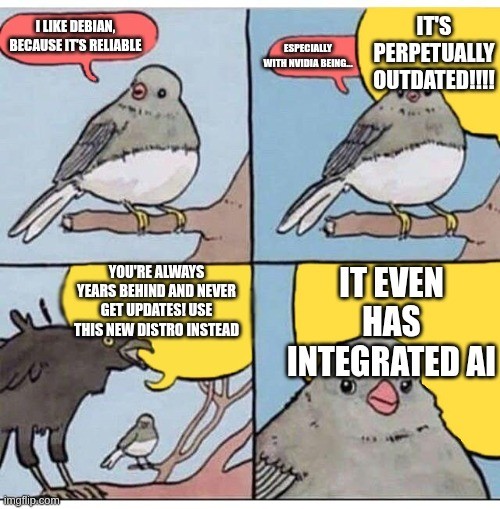
Got to add, if you are a Gnome user like myself, but one that likes to do a lot of customizations of the desktop via extensions, then Debian being behind by a version or two is actually to ones benefit, as then the extensions I like to use are all working already, rather than waiting for updates.
Flatpak has walked into the chat, making it easy to get up to date packages for nearly any piece of software. And at this point Debian 13 is easy to setup and does everything I need. Sure, other distros might have a few extra codecs or dependencies installed by default, but it’s also easy to do a “sudo apt install …”
Sure flatpak makes it easy to get software, but getting those apps to integrate with the rest of the system can be a pain in the ass. I’m talking about things like not being able to copy and paste between apps via the clipboard. People shouldn’t have to mess with flatseal to get basic functionality working. I really hope they spend some time improving that type of thing soon.
I can’t think of a single example where I’ve had an issue with not being able to copy & paste between flatpak & deb installed apps. It’s also fairly easy to even match themes between flatpak & deb installed apps now, just need to pick a cross compatible theme (Orchis is my current favorite) and run a terminal command.
I just had to mess with flatseal yesterday so that I could copy and paste between Firefox and Konsole in Fedora, so it’s pretty fresh in my mind. That’s not the only example I’ve run in to either, just the latest. The other one that immediately jumps to mind was getting Orca Slicer to recognize that my system theme is in dark mode.
Literally nobody cares if the packages are outdated. Only a tiny minority actually needs the most recent versions, and it’s still only for a handful of packages.
Most people don’t need all their packages to stay the same for 3 years either. There’s been a time or two where Debian repos simply didn’t have what I needed. If I have to enable 3rd party repos to get up to date tooling, why not just run a distro that gets updates at least twice a year or something?
Anyway, now I’m on rolling release and I haven’t actually had any stability issues. This is my everyday work and gaming desktop PC, not a server where I would never want anything to change because it’s all running exactly the way it needs to. Servers get LTS distros.
I don’t really use anything new tbh though…
Alot of people are stuck in the infinite hype cycle
As a mint user I run into outdated software problems regularly. I will move to fedora as soon as I am able to, because that shit is annoying af.
That said, with some knowledge you are still able to run most latest releases, but I still have to debug until I realise it’s just some outdated version.
Flatpaks (or appimages or docker images) can help when you must have the newest versions of applications.
Can you give an example? I’m a daily user of Mint on my laptop and desktop and haven’t run into any problems so I’m curious what you’re running into.
Mainly nieche python related things. E.g. I needed numpy and looked at the docs and then there wasn’t a function I looked up. (But also a python application and I am too stupid to make a virtual environment to get pip going). Same with documentation and version of a scientific program I used. Its just a hassle sometimes to find for a 2-4 year old version the right docs.
Most of the time things are fine. Often there are flatpacks or appimages. Sometimes there is pain.
For the average user mint is 100% viable.
I’ve used Debian as my default distro for headless boxes for over 2 decades, and my biggest gripe is it installls
nanoinstead ofvimas the default text editor, the first thing I need to fix after every install.My second biggest complaint is it will install a GUI unless you’re careful.
Sorry, I forgot that I wasn’t supposed to use the latest version of a productivity app. I was supposed to use a 2 year old version, with many features missing. If I call out that, I’d be an M$ shill FUDposting about Linux. Everyone knows that using a computer was supposed to be about tinkering with the open source OS on it, not making things with it.
Ubuntu is al…
SNAPS! YOU HAVE TO USE SNAPS!!!
Can you explain me why there is such hate against snaps? (Honest question). I switched over a year ago from windows to kubuntu and realized that multiple flatpaks have problems with strange behavior like handling notifications correctly, but snaps didn’t. So it was nice to have an alternative source. But thats the user point of view.
For me, the issue with Snaps are that they are coupled so tightly with Ubuntu that they don’t work well on other distros, especially if your distro doesn’t use AppArmor and uses SELinux or other security systems instead.
I also dislike that Canonical went out of their way to remove flatpaks from all Ubuntu spins and they have hardcoded apt to install snaps for certain apps like Firefox instead of actually system deb package like apt is expected to do. That is deliberately misleading users.
Another thing that contributes to the average distaste was that, early on, Snaps had a terrible spool up time. It was so bad that many people thought their applications were broken. While that is no longer the case, the stigma from those early slow and buggy Snaps, like the Firefox snap, is still there.
Run mount or df on a sane distro. Reasonably small list of mounts. Now run it on a distro with snaps. You get an insane list of every app you’ve installed. It’s a gory mess.
Snaps are closed source - the antithesis of the Unix community - and an attempt by Canonical to entrap same into their zeitgeist.
For me, one thing is that interoperability between applications can be screwed. For example, when I was on Ubuntu, firefox came as a snap and I could not get the integration with my password manager going easily.
I also had some tooling to make tiny boot media from a fairly typical boot distribution, but snaps really blew up the concept.
I didn’t dig too deeply, but at first blush snap seemed tied to Canonical’s “store”, while flatpak wasn’t particularly locked in to any registry.
Also, at least at one point they were saying they were going to package everything as a snap, up to and including the kernel. Which means at some point I wouldn’t be able to tell if a snap would be something isolated by container mechanisms or just a traditionally run payload. I don’t know if anything like that came to pass for real since I left them behind at that point.
FWIW, Debian “unstable” is reasonably up-to-date, and is not that unstable for a personal desktop computer. I have some wonky issue in upgrade once every couple of years at most.
Debisn unstable is about as stable as any other distro on the planet. Stable is the kind of stable you’d want for a nuclear reactor or something.
Debian is one of the most stable systems there is.
And it can run on practically anything
Personally, I could never use a “stable” distro. I want to touch new software the millisecond it comes out. But I could also see why someone else would prefer a stable distro. It all comes down to personal preferences. If you want your system to outlast you, that’s fine. If you want to test out whatever new junk KDE has to offer (junk not as in trash), that’s also fine
That’s why I like Sid
deleted by creator
Neon is the right balance for me here. Get new KDE packages early, everything else is stable.
The best linux distro is the one that you’re used to. Can’t imagine going to the effort of installing a whole new distro just because I’m bored of Mint
I’m the kind one that distro-hops a lot out of curiosity and spite, just to try new things, but when I landed on Arch, I already knew that Arch was going to be my lifelong main distro, so I kinda understand what you say.
The best linux distro is the one that you’re used to.
This is my take on programming languages. For me, the best language is the one with which I am the most familiar. Me at my Visual Basic peak could code rings around the me that was first learning Objective-C (if you ignore the fact that there was never a way to write iOS apps in Visual Basic).
I used Mint for like 4 years, but it wasn’t exactly a “perfect fit” for me. Eventually I started distro-hopping and trying a whole bunch of stuff. I’m reasonably satisfied with CachyOS for now. It’s a better fit, but still not exactly what I’m looking for; which may or may not actually exist.
Seriously. When I get bored with Mint I just rice it some more. No need to restart when what I’ve got is rock solid.
No hate to the other distros either, I just prefer using what I’m already used to
I just want it to work, and Mint does. It just works.
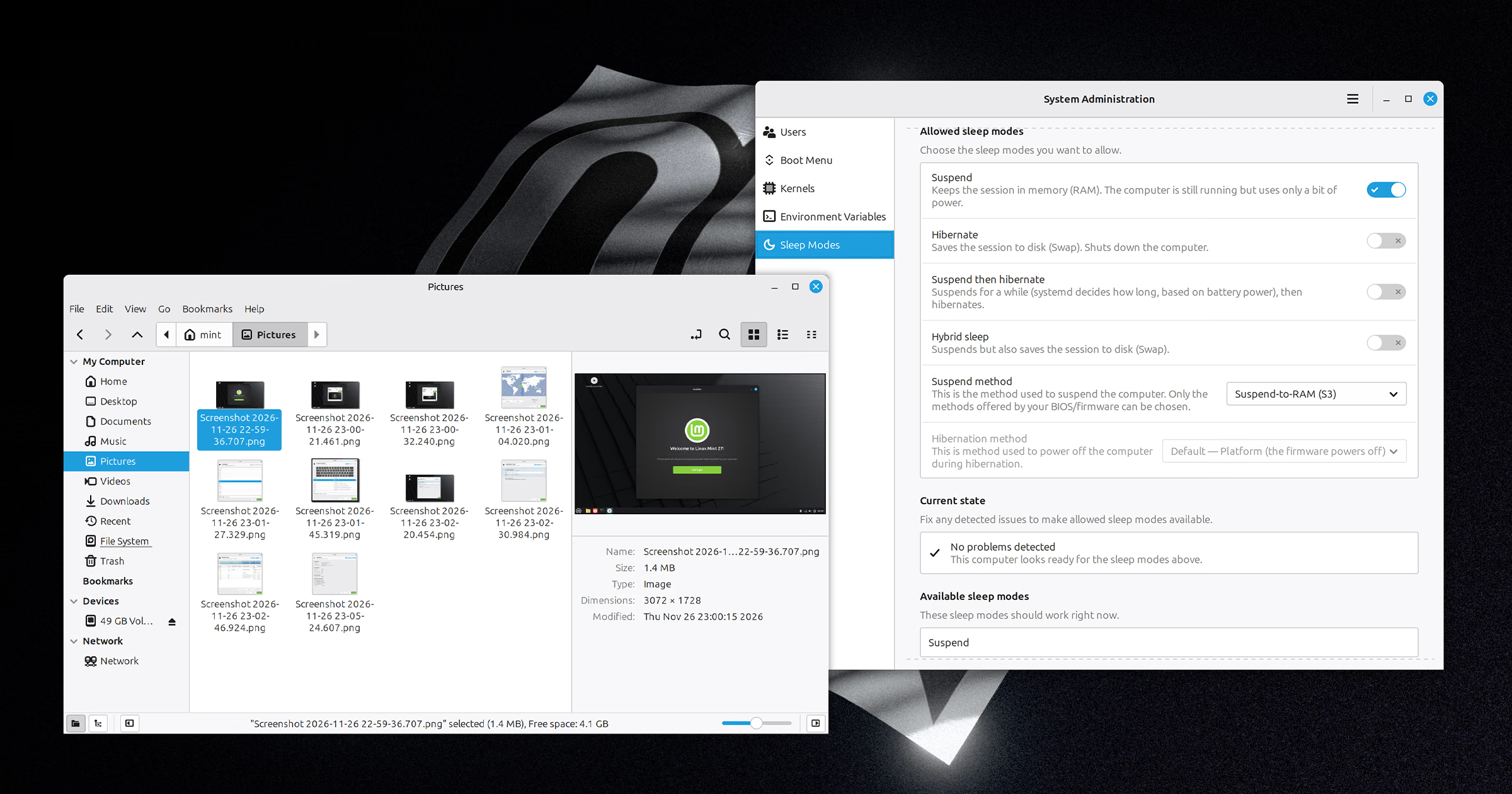
Oh, and Nemo is getting an image and video preview in version 27.
https://www.omgubuntu.co.uk/wp-content/uploads/2026/11/hiernate-linux-mint-27.avif
Nemo is getting an image and video preview in version 27.
All GUIs could gain so much by copying MacOS from ten years ago. Like, Finder shows file previews when pressing space. Okay, I didn’t use Finder because I prefer two-pane managers. But, MacOS also has the latest downloads fan out from a dock icon, which is immensely useful. Imagine my elation when I discovered that the spacebar preview also works when hovering on the fanned-out icons of the downloaded files.
I ‘moved’ from mint to bazzite because I wanted something for the TV and for gaming. I bought a new PC for this, my old notebook still have my reliable mint install that I use for serious work, but I use way more the HTPC bazzite.
I’m bored of Mint
“Beginner” distros are where its at
Yeah, Mint was not working for me, but Zorin OS does well. Why change, when everything works?
Unless it’s Ubuntu, of course.
Honestly Ubuntu is the only distro I actually dislike. Hate gnome
Can you even call that thing that Ubuntu ships GNOME anymore? They pruned out features, added a task bar … There’s other reasons to hate on Ubuntu.
The Gnome Devs are proud that Ubuntu has stripped out features. They are considering copying those ideas.
One of these days they’re going to make GNOME be two buttons:
Open Browser
Open Terminal
But that seems to be what technology is these days. Bored? Change everything!
If you like Debian, sure, use it.
I actively dislike Debian for the reasons mentioned in the meme. So “stable” it’s completely useless.
Fedora all the way
Every time I touch Debian I inevitably run into a bug that was fixed years ago upstream (Most recent one was Debian shipping a 4 year old or so version of
fdiskthat couldn’t align partitions properly on certain drives). Good reminder that “stable” doesn’t mean reliable, it means unchanging.I’ve in fact found CachyOS very reliable despite being extremely “unstable” in Debian terms. Opensuse tumbleweed gave me more trouble, but I think that was mostly before nvidia moved to the open kernel driver.
I find debian quite usefull. I just want a stable OS without too much tinkering. But I’m also the kind of person who rarely jumps on new trends in general. I like to wait and see if it holds water.
You can say a lot about Debian but “unstable” is not it.
Agreed
Except that “never receives updates” is just wrong. There are point releases between the versions, fixing a lot of security issues and bugs. And in case of a big one, the security fix is being provided as fast as humanly possible.
Yeah, security backports on years-old versions though. For example, Trixie currently ships node v20, which is marked EOL upstream
Fuck omarchy. Fascist distro aside, the “I use arch btw”, but actually omarchy crowd is disgusting.
Fedora has been surprisingly smooth.
Fedora supports Framework that supports both Omarchy and DHH himself, so they’re accomplices and participants in said fascism.
And even without the fascism, having like 20+ agents on your system sounds like a nightmare. Even if you like AI i just don’t understand why on earth you’d want your OS to be that bloated up.
Yeah, even if you actively want to incorporate AI, that just sounds like you’re losing control over your own system
Are there people actually using that distro? I mean, a significant number of people. That distro feels like fake hype to me
Maybe newbies. I see influencers (probably paid) promotions about it 🤢🤢🤢
DHH’s dot files in an ISO definitely tests the definition of distro IMO.
He is rich enough and has enough money share to get the word out but I have not really seen any large org or community form around it. Which is probably a good thing
I don’t mean this in seriousness, as I agree with your assessment of Omarchy, but you can create a conspiracy style graph of:
Fedora -> Red Hat -> IBM -> Nazi Germany
Again, I don’t mean this to imply this is the same as Omarchy, or even to take this seriously (as Red Hat was acquired by IBM only a few years ago). Also, Omarchy is basically:
Omarchy -> White Supremacy
Creating a graph like that can also liken you to Lunduke and metux (Xlibre). And with your assessment of Omarchy, you probably don’t want that yourself. https://drewdevault.com/weird-guys/
Meh, I have no love for any of those weird little guys (seen that list, love that list). The list is just for personal lulz.
What even is your point then if no one should take it seriously?
The point is entertainment.
Debian is amazing. I’d use Fedora if you want more cutting edge stuff. Arch if you know what you’re doing and want the latest of anything.
Personally, I don’t game very much, so Debian suits my needs. It’s rock solid.
I use Win XP btw.
I use Mint with an XP theme BTW.
Theres a new Debian gaming initiative, but I havent had any issues gaming on any Debian system I have. I just use back ports kernel and mesa.
There are Debian-based distros with a focus on gaming too, such as PikaOS or SparkyLinux GameOver Edition.
Yeah I pretty much am exactly the same way. Debian for stable things, Fedora for everything else.
Debian is great and is what I use at work. I’ve been using the same install for years without issue.
I just tried Arch on my PC but found I spent two hours out of the gate working on glitches in some of my must-have software. I realized I didn’t want that to be my life, so switched to Fedora. It’s a similar user experience but everything instead just works.
Agreed. My community needs something stable for our infrastructure, so we go with Debian.
How about this for fueling the fire:
I like Bazzite and Ubuntu? I like Rasberry Pi OS, and I like Steam OS. I use Redhat/Fedora Linux at work. Actually, my OS at work is Windows, and I have to work with engineers that use Apple machines. If they don’t use docker/podman, guess how much of a nightmare that can be?
And know what? I think everyone who rigorously sticks to and argues for a particular Linux distro is in their right to, but ultimately behaving detrimentally to the Open Source community.
The whole fucking point of different distros is different ways of doing things. Otherwise y’all would be no different than MacOS or Windows.
“I use arch btw” is a meme. Don’t be like that. Leave Debian alone. Debian is good at what it does.
Amen brother. That’s the beauty of FOSS. More distros just means more choices, not more competition. There’s plenty of room for everyone when it’s not about some rich asshole’s bottom line
Couldn’t agree more, mate.