Well it is hurting climate in one way and that’s by methane emissions. Growing any crop in standing water is gonna create an anaerobic environment where methane is released. Rice therefore is expected to have larger environmental footprint than other grains because the carbon dioxide emissions should be similar as rice and other grains need similar amounts of fertilizer. Animal agriculture still has a larger share in the methane pie but rice’s contribution is not insignificant
Given the number of calories per tonne of methane produced, no, no it’s not hurting the climate.
This kinda complain is the same as ‘well if we just eliminate humans we’ll solve climate change,’ like yeah, no shit. But the point is keeping humans alive and rice is uniquely good at just that.
I swear, whenever someone talks about how “humanity” is killing the planet, or “humanity” is evil or something like that, I get so irrationally mad. It’s not humanity, it’s like less than 1% of people that are bringing this planet down
Reread try again. I’m not commenting on animal agriculture; and rice fields are the least problematic mass produced crop for biodiversity given they act as wetlands and use no chemical pesticides or herbicides.
If more vegans used a rice based diet instead of corn, potatoes, lentils, or chickpeas we’d actually have fewer animal deaths given the ridiculous amount of pesticides needed for monocultures of those plants.
I’m just replying to the comment above mine that says rice is not hurting the climate. That’s simply factually wrong. I’m also comparing rice to other grains, not rice to growing nothing at all. We could improve the climate impact of agriculture by switching to other carbs that are just as productive while having a lesser environmental impact, such as Maize and potatoes. However I don’t think we should actually do that as some people eat rice for cultural reasons and the impact rice has, as many have pointed out, is dwarfed by animal agriculture. So switching away from rice while still eating beef would feel a bit hypocritical. However it’s still true that rice is far from the most environmentally friendly carb source.
Rice is one of the most environmentally friendly carb sources, and in its native environments is an essential plant. Corn takes up more space and the production and refining creates more CO2 than rice. Potatoes are much more vulnerable to rot and much more likely to fail, not to mention the much higher fertilizer requirements.
Climate change is not one thing. Methane isn’t the enemy. Hell CO2 isn’t the enemy. It is taking out things out of balance. If we were to eliminate rice and just grow corn, yes, we’d drop 10% of methane production… except we wouldn’t because corn requires 5x the fertilizer and fertilizer production is a larger contributor to GHG emissions than aviation and shipping.
Corn is also horribly space inefficient outside the US. Not just outside the Americas, but outside specifically the midwest in the US. Despite it now being attempted to be grown on every continent there is no place on Earth besides the US and Canada that corn becomes more productive per hectacre than rice. It simply cannot replace rice, which is more productive on every single other continent.
So that’s 5x the fertilizer, at least 1.5x the space (up to 3x the space) which then logarithmically increase the amount of CO2 produced for transportation and production, all while destroying native ecosystems (or at least ecosystems that have adapted to rice farming over the last few thousand years), oh and we can’t forget water management systems would need to change drastically so add 50 years of construction to any CO2 calcs.
‘Methane bad’ is true, sure, but we can’t look at one single source, which provides HALF OF ALL CALORIES CONSUMED BY HUMANS, and say that’s a thing that needs to switch. If we replaced corn with rice tomorrow the world would have a net negative GHG production from where we started. The same is not true in reverse, despite rice causing a minor amount of separate methane production.
Doesn’t rice grown without standing water eliminate that problem? I have no clue about which varieties one could grow like this though. Or how much of a harvest one could expect in comparison.
Rice is grown in water because it makes it easier to farm. It’s not that it needs the water, it’s that it doesn’t mind the water while most of the weeds very much mind the water.
I don’t know either, but the places where I’ve seen rice growing is on very steep mountainous areas where would have been jungle, and lots of rain. It’s deforested to make way for rice, and there’s not much else humans can use it for. So while people can comment it can be done without water, places like this I think it would be a challenge, especially when yeild is important to very poor farmers, and a huge population needs feeding.
Sorry but you just produced a whole lot of bullshit. You admit that maize is more productive than rice in the US and Canada. But you never reflect more on that. The reason that listed average yields for maize is lower than for rice in most other countries has a very simple explanation. Rice is higher value per kg and if you can grow rice in a certain environment, you are very likely to do so. Maize then gets pushed to less productive land that can’t support rice, either because it’s too mountainous or it’s too dry. However what we see is that when maize and rice are grown on the same land the maize tends to either yield similar or more than rice. A few years ago I made an agricultural study trip to Indonesia where they grew rice everywhere where rice could be grown but grew mostly maize on the rest of the land. Traditionally they used to have highland rice varieties that could be grown without irrigation but they were mostly abandoned when maize came, because it was far more productive. All animals where also fed maize because maize was cheaper to produce than rice. Even animal farmers whose grain never ended up in market, were growing maize to feed their chickens, because it yielded the most. Maize has 4C photosynthesis that’s more productive than rice’s 3C photosynthesis in subtropical and tropical climates.
Now the claim you make that maize uses 5x more fertilizer I have no idea where you got that from, but I’m guessing straight out of your ass. If we are talking nitrogen it’s about 22kg per ton for maize and 18kg per ton for rice. However since maize has a higher protein content the nitrogen use efficiency ends up being close to the same. And nowhere near the 5x fertiliser claim you pulled. You also briefly mention water but rice is almost universally irrigated while maize is chiefly rainfed.
Carbon release from biological sources are all net neutral. Every single atom released came from the environment in the first place. Every story about grain or cows ruining the environment is propaganda to protect the real culprit in fossil fuels. Every single atom from that source is extra material that had been sequestered for millions of years. That is the only additive source we have the ability to stop.
Yes. Roughly 1:5 calories consumed by humanity are rice, so based on the above chart we could, hypothetically, make all calories rice without increasing total methane. Though, it’s worth noting, the “replacing cattle calories” part of that would be less than a 1% increase in rice’s methane footprint resulting in a 30% overall reduction. Reclaiming several billion acres of cattle land would just be icing.
I love rice, but for variety let’s keep some other calories in our mix, OK? Not beef, that’s fine. But I like some sauce and maybe peanuts and veggies and some soy/pea/bean (in whichever variety)
No. My hypothetical statement concerning human methane release comparing different food production was meant to be taken as a bold new era of forced rice eating for everyone always forever. We’ll make it a crime not to have rice in your mouth unless you’re asleep or have a doctor’s note.
Rice doesn’t have to be grown in flooded paddies, that’s just an ancient, chemical-free way to prevent weeds from growing. You could still grow rice the same way you’d grow wheat or corn and it can actually be less work to do it that way. It would, of course, require more reliance on herbicides for weed control, though, which is its own can of worms. The water also allows other means of food production to happen alongside the rice growing, such as raising fish or ducks. I wonder if symbiotic dual-use of the water would offset, or even directly reduce, the relatively higher methane levels that might be generated within the water. Bonus points if you hook up a turbine to the outflow when you go to drain your paddies.
These are definitely interesting perspectives. However, even though rice can be produced with much fewer emissions, today the emissions are high. This is why @Barley_Man@sopuli.xyz is perfectly right in saying that rice is hurting the climate.
(Dry farming accounted for just 4% of global rice production in 2022 [1].)
Cool chart, but as other have noted it’s more than a little misleading without context. Rice accounts for about 10X more of humanity’s total caloric intake than beef. Weighted as such, Rice becomes a lot less significant.
I’ve known a lot of people that do this research for a living. You want to know how we could have a much bigger impact without worrying what people eat: grow food locally.
It’s actually very simple. Shipping things around the world multiple times before they even get to our plates is absolute insanity.
I think your average American doesn’t even understand that most of the world eats food based on what’s in season. We just ship it in from all over so that there’s barely such a thing as an item being unavailable due to it being out of season.
Afaik Rice doesn’t have to be submerged. It can be, so it’s done for weed control. Now we can do weed control with lasers, so we’ll see what the future holds.
Yes, except that the water in a rice paddy is not particularly stagnant in the first place.
You know, it’s a food crop, so it’s generally maintained.
People don’t want to eat rice that comes out of a sick looking pool of water, and nobody wants to live near a ton of stagnant ponds where mosquitos will go crazy.

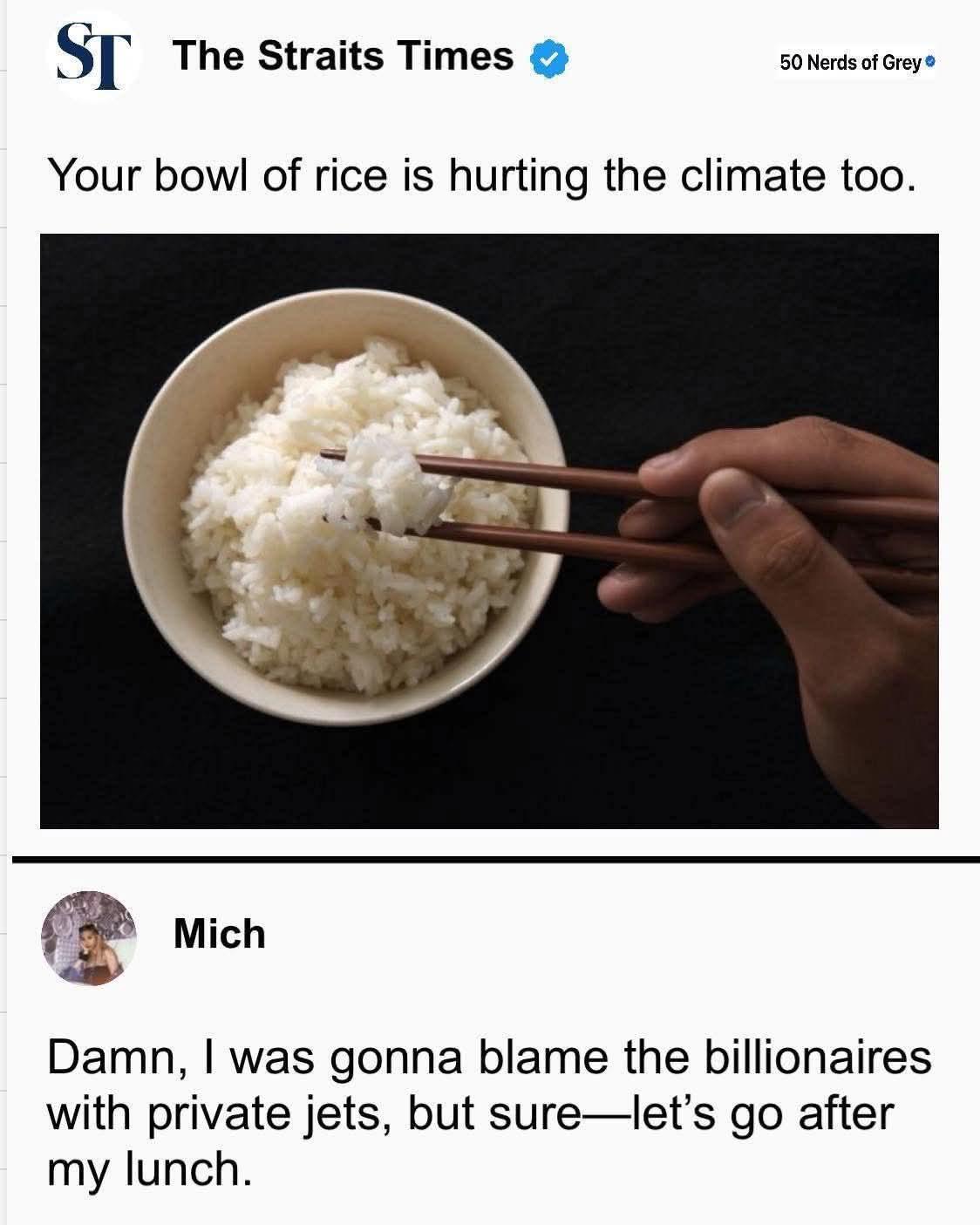
Well it is hurting climate in one way and that’s by methane emissions. Growing any crop in standing water is gonna create an anaerobic environment where methane is released. Rice therefore is expected to have larger environmental footprint than other grains because the carbon dioxide emissions should be similar as rice and other grains need similar amounts of fertilizer. Animal agriculture still has a larger share in the methane pie but rice’s contribution is not insignificant
Given the number of calories per tonne of methane produced, no, no it’s not hurting the climate.
This kinda complain is the same as ‘well if we just eliminate humans we’ll solve climate change,’ like yeah, no shit. But the point is keeping humans alive and rice is uniquely good at just that.
deleted by creator
And now together: Change your diet for the climate, eat the rich 👏👏
*with rice
capitalists really hate this one simple diet trick!
I swear, whenever someone talks about how “humanity” is killing the planet, or “humanity” is evil or something like that, I get so irrationally mad. It’s not humanity, it’s like less than 1% of people that are bringing this planet down
Some of us just like to keep our options open.
And here i was worried that we have to stop torturing animals.
Reread try again. I’m not commenting on animal agriculture; and rice fields are the least problematic mass produced crop for biodiversity given they act as wetlands and use no chemical pesticides or herbicides.
If more vegans used a rice based diet instead of corn, potatoes, lentils, or chickpeas we’d actually have fewer animal deaths given the ridiculous amount of pesticides needed for monocultures of those plants.
I’m just replying to the comment above mine that says rice is not hurting the climate. That’s simply factually wrong. I’m also comparing rice to other grains, not rice to growing nothing at all. We could improve the climate impact of agriculture by switching to other carbs that are just as productive while having a lesser environmental impact, such as Maize and potatoes. However I don’t think we should actually do that as some people eat rice for cultural reasons and the impact rice has, as many have pointed out, is dwarfed by animal agriculture. So switching away from rice while still eating beef would feel a bit hypocritical. However it’s still true that rice is far from the most environmentally friendly carb source.
And I replied telling you you were wrong.
Rice is one of the most environmentally friendly carb sources, and in its native environments is an essential plant. Corn takes up more space and the production and refining creates more CO2 than rice. Potatoes are much more vulnerable to rot and much more likely to fail, not to mention the much higher fertilizer requirements.
Climate change is not one thing. Methane isn’t the enemy. Hell CO2 isn’t the enemy. It is taking out things out of balance. If we were to eliminate rice and just grow corn, yes, we’d drop 10% of methane production… except we wouldn’t because corn requires 5x the fertilizer and fertilizer production is a larger contributor to GHG emissions than aviation and shipping.
Corn is also horribly space inefficient outside the US. Not just outside the Americas, but outside specifically the midwest in the US. Despite it now being attempted to be grown on every continent there is no place on Earth besides the US and Canada that corn becomes more productive per hectacre than rice. It simply cannot replace rice, which is more productive on every single other continent.
So that’s 5x the fertilizer, at least 1.5x the space (up to 3x the space) which then logarithmically increase the amount of CO2 produced for transportation and production, all while destroying native ecosystems (or at least ecosystems that have adapted to rice farming over the last few thousand years), oh and we can’t forget water management systems would need to change drastically so add 50 years of construction to any CO2 calcs.
‘Methane bad’ is true, sure, but we can’t look at one single source, which provides HALF OF ALL CALORIES CONSUMED BY HUMANS, and say that’s a thing that needs to switch. If we replaced corn with rice tomorrow the world would have a net negative GHG production from where we started. The same is not true in reverse, despite rice causing a minor amount of separate methane production.
Doesn’t rice grown without standing water eliminate that problem? I have no clue about which varieties one could grow like this though. Or how much of a harvest one could expect in comparison.
Rice is grown in water because it makes it easier to farm. It’s not that it needs the water, it’s that it doesn’t mind the water while most of the weeds very much mind the water.
I don’t know either, but the places where I’ve seen rice growing is on very steep mountainous areas where would have been jungle, and lots of rain. It’s deforested to make way for rice, and there’s not much else humans can use it for. So while people can comment it can be done without water, places like this I think it would be a challenge, especially when yeild is important to very poor farmers, and a huge population needs feeding.
Sorry but you just produced a whole lot of bullshit. You admit that maize is more productive than rice in the US and Canada. But you never reflect more on that. The reason that listed average yields for maize is lower than for rice in most other countries has a very simple explanation. Rice is higher value per kg and if you can grow rice in a certain environment, you are very likely to do so. Maize then gets pushed to less productive land that can’t support rice, either because it’s too mountainous or it’s too dry. However what we see is that when maize and rice are grown on the same land the maize tends to either yield similar or more than rice. A few years ago I made an agricultural study trip to Indonesia where they grew rice everywhere where rice could be grown but grew mostly maize on the rest of the land. Traditionally they used to have highland rice varieties that could be grown without irrigation but they were mostly abandoned when maize came, because it was far more productive. All animals where also fed maize because maize was cheaper to produce than rice. Even animal farmers whose grain never ended up in market, were growing maize to feed their chickens, because it yielded the most. Maize has 4C photosynthesis that’s more productive than rice’s 3C photosynthesis in subtropical and tropical climates.
Now the claim you make that maize uses 5x more fertilizer I have no idea where you got that from, but I’m guessing straight out of your ass. If we are talking nitrogen it’s about 22kg per ton for maize and 18kg per ton for rice. However since maize has a higher protein content the nitrogen use efficiency ends up being close to the same. And nowhere near the 5x fertiliser claim you pulled. You also briefly mention water but rice is almost universally irrigated while maize is chiefly rainfed.
Carbon release from biological sources are all net neutral. Every single atom released came from the environment in the first place. Every story about grain or cows ruining the environment is propaganda to protect the real culprit in fossil fuels. Every single atom from that source is extra material that had been sequestered for millions of years. That is the only additive source we have the ability to stop.
Is still looks like the world population could use rice as the main source of carbs and it wouldn’t be nearly as harmful as cattle.
Yes. Roughly 1:5 calories consumed by humanity are rice, so based on the above chart we could, hypothetically, make all calories rice without increasing total methane. Though, it’s worth noting, the “replacing cattle calories” part of that would be less than a 1% increase in rice’s methane footprint resulting in a 30% overall reduction. Reclaiming several billion acres of cattle land would just be icing.
I love rice, but for variety let’s keep some other calories in our mix, OK? Not beef, that’s fine. But I like some sauce and maybe peanuts and veggies and some soy/pea/bean (in whichever variety)
No. My hypothetical statement concerning human methane release comparing different food production was meant to be taken as a bold new era of forced rice eating for everyone always forever. We’ll make it a crime not to have rice in your mouth unless you’re asleep or have a doctor’s note.
Who’s using cattle as their main source of carbs?
Rice doesn’t have to be grown in flooded paddies, that’s just an ancient, chemical-free way to prevent weeds from growing. You could still grow rice the same way you’d grow wheat or corn and it can actually be less work to do it that way. It would, of course, require more reliance on herbicides for weed control, though, which is its own can of worms. The water also allows other means of food production to happen alongside the rice growing, such as raising fish or ducks. I wonder if symbiotic dual-use of the water would offset, or even directly reduce, the relatively higher methane levels that might be generated within the water. Bonus points if you hook up a turbine to the outflow when you go to drain your paddies.
These are definitely interesting perspectives. However, even though rice can be produced with much fewer emissions, today the emissions are high. This is why @Barley_Man@sopuli.xyz is perfectly right in saying that rice is hurting the climate.
(Dry farming accounted for just 4% of global rice production in 2022 [1].)
It’s impossible to ‘hurt the climate’ using non-ancient non-sequestered sources.
Cool chart, but as other have noted it’s more than a little misleading without context. Rice accounts for about 10X more of humanity’s total caloric intake than beef. Weighted as such, Rice becomes a lot less significant.
I’ve known a lot of people that do this research for a living. You want to know how we could have a much bigger impact without worrying what people eat: grow food locally.
It’s actually very simple. Shipping things around the world multiple times before they even get to our plates is absolute insanity.
I think your average American doesn’t even understand that most of the world eats food based on what’s in season. We just ship it in from all over so that there’s barely such a thing as an item being unavailable due to it being out of season.
Afaik Rice doesn’t have to be submerged. It can be, so it’s done for weed control. Now we can do weed control with lasers, so we’ll see what the future holds.
Seems like they are trying to avoid saying “animal agriculture”
“Let them eat grass”
Rice is a grass. So is wheat. So is corn. So is barley. So are oats.
Humans fucking love grass.
Technically, rice is a type of grass.
Can this be solved by making the water just a little bit less stagnant?
Yes, except that the water in a rice paddy is not particularly stagnant in the first place.
You know, it’s a food crop, so it’s generally maintained.
People don’t want to eat rice that comes out of a sick looking pool of water, and nobody wants to live near a ton of stagnant ponds where mosquitos will go crazy.