
Not self-replicating. It’s like a knife dildo that remodels your body into a knife dildo factory.

- 0 Posts
- 1.6K Comments
Joined 2 years ago
Cake day: June 11th, 2023
You are not logged in. If you use a Fediverse account that is able to follow users, you can follow this user.
 30·1 day ago
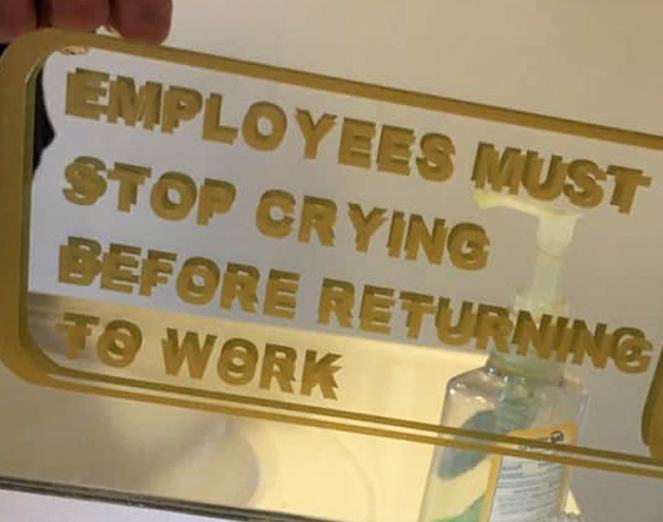
I love these old, mostly-harmless traditions.
 9·1 day ago
Not all wealth is a problem. His yachts and their maintenance isn’t actually the problem here: that money was spent. That money put shipbuilders and maintainers to work. The assets he gets from spending isn’t the problem.
The problem is his registered securities: his stocks, bonds, and other financial assets. These assets aren’t just wealth. They generate wealth by taking it from the working class.
What we need is a tax on all registered securities. We will exempt the first $10 million held by a natural person. This tax is payable in shares of the security. IRS liquidators will offer these shares in small lots, comprising no more than 1% of total traded volume. This minimizes the effect of the sale of these shares on their value.
The only way to keep those shares untaxed is for a natural person to hold them. They will have greater value in the hands of the working class than the ultra-rich. This tax structure will shift ownership of companies toward the working class.
Every McDonald’s employee should be compensated, in part, with shares in the company.
 2·2 days ago
Nobody is gonna touch this guy, except to high-five him.
It’s been a pleasure. My hope is that in future arguments, you will remember your own agency and empowerment.

Philanthropist? More like Philanthrapist, amiright?
I utilized conjugations of your own words:
You are seriously arguing that the corruption in our police system means there is no protection? This is objectively false.I would trust an officer over Ultragagginggunnut any day of the week.
(Emphasis mine)
You identified two possible “protectors”. Your argument failed to consider yourself as a third option. That oversight is a fundamental flaw in your initial argument.
You are not a “prisoner”. You are the person in the best position to protect you. That fact is not represented in your initial argument.
I’m sorry you feel that way, but none of what you’re saying in any way addresses my point: your argument is fundamentally based on the aforementioned false dichotomy. You are the most reliable protector of you. Nobody has a greater motivation to protect you than you. Regulation should recognize that fact.
I understand it may seem like I am “hyper focused” on this rebuttal to your argument, but that is only because you have asked for further response, without actually addressing my initial argument. You’ve presented no new arguments for me to consider.
What are you waiting for? I have responded twice before this comment. Your comment is premised on a false dichotomy. When we eliminate that premise, the remainder of your comment doesn’t make much sense.
One route forward: You could support your position on a different premise. Another route: You could abandon your previous position and adopt a new one. I eagerly await your choice.
Certainly. Thank you for your patience, and for the opportunity for discussion.
I respectfully and summarily reject the underlying premise of what you were saying. Your comment did not consider that you are the person best capable of providing your own “protection”.
I submit that the regulatory environment needs to recognize and respect that fact.
I would trust an officer over Ultragagginggunnut any day of the week.
False dichotomy. Those aren’t the only choices.
In your entire comment, you failed to realize that “Doomsider” is a perfectly viable option.
With “Doomsider” being an option for you, “officer” should be considered a distant second.
That’s… Amazing. What a worthless site.

It exists to fuck up search results.
I’ve stopped a half dozen people from doing something like this… Every single one of them was filling up to the maximum pressure listed on the sidewall.
The sidewall pressure is only the correct pressure at the maximum load on the tire. The maximum rated load on the tire is often nearly twice the vehicle’s maximum weight rating, so the sidewall pressure is never the correct pressure for your vehicle.
The correct pressure for each tire on your vehicle is listed on a tag on the driver’s door, or door frame.
 2·4 days ago
Same. If you want to see sexy, though…
(B17 prototype using Allison engines and P-38 nacelles)
 65·5 days ago
I would say that if you find this particular killer’s motives personally threatening, you should probably resign from your day job and move into your bunker.
 2·5 days ago
Your mother said a lot of things. I didn’t know how religious she was.
Wife’s right. This is an example of the pareto principle. 80% of your shit fits in 20% of the categories needed to properly organize your shit. 80% of the needed categories account for only 20% of your shit. 20% of your shit (and 80% of the needed categories) are in that drawer.